Paper accepted at NeurIPS 2026: “Neural Reconstruction of LiDAR Point Clouds under Jamming Attacks”
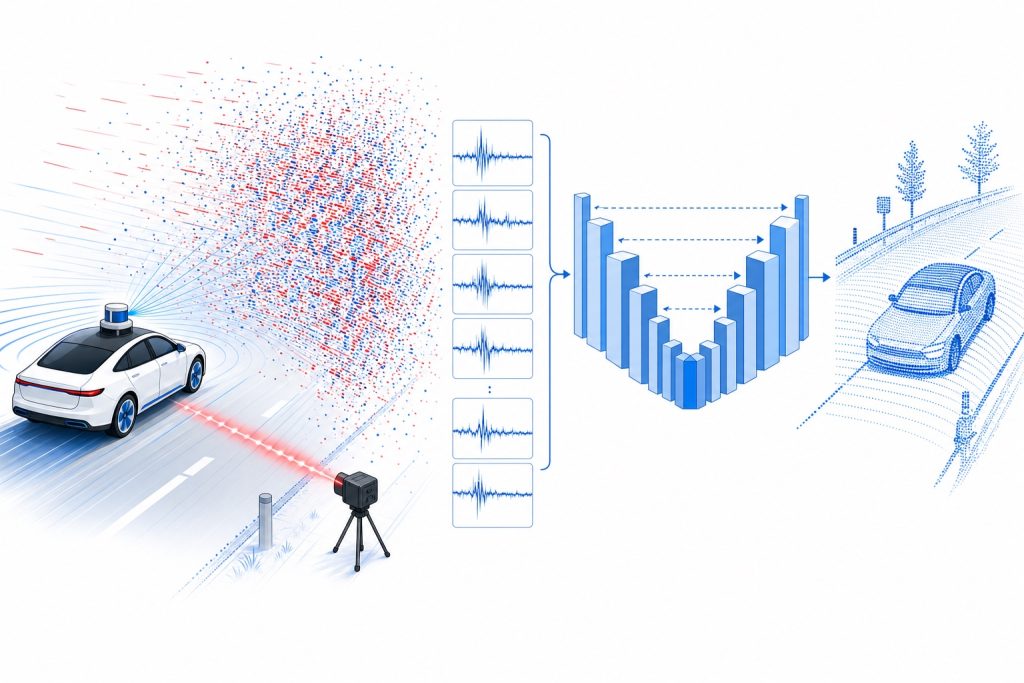
LiDAR sensors are critical for autonomous driving perception, yet remain vulnerable to laser-based attacks. Jamming attacks inject high-frequency laser pulses that completely blind a LiDAR by overwhelming authentic returns with malicious signals. This work discovers that while the point cloud becomes randomized, the underlying full-waveform data retains signatures that distinguish attack signals from legitimate returns.
Building on this finding, the paper proposes PULSAR-Net, which reconstructs authentic point clouds under jamming attacks by leveraging the previously underutilized intermediate full-waveform representation and the simultaneous laser sensing available in modern LiDAR systems. PULSAR-Net adopts a U-Net architecture with axial spatial attention designed to separate attack-induced signals from authentic object returns in the full-waveform representation. To address the lack of full-waveform data under jamming attacks in existing LiDAR datasets, the authors also introduce a physics-aware pipeline that synthesizes realistic full-waveform representations under attack. Despite being trained exclusively on synthetic data, PULSAR-Net reconstructs 92% and 73% of vehicles obscured by jamming attacks in real-world static and driving scenarios, respectively, making it the first practical defense capable of recovering point clouds under LiDAR jamming attacks. The domestic presentation of this work received the MIRU Student Excellence Award at MIRU2026 in Nagasaki in August 2026. The paper will be presented at NeurIPS 2026, held in December 2026 across three cities: Sydney, Atlanta, and Paris.
[Paper]
Ryo Yoshida, Takami Sato, Wenlun Zhang, Yuki Hayakawa, Shota Nagai, Kentaro Yoshioka, “Neural Reconstruction of LiDAR Point Clouds under Jamming Attacks via Full-Waveform Representation and Simultaneous Laser Sensing,” The Fortieth Annual Conference on Neural Information Processing Systems (NeurIPS 2026), December 2026.