Paper accepted at NDSS 2027: “Privacy in Motion”
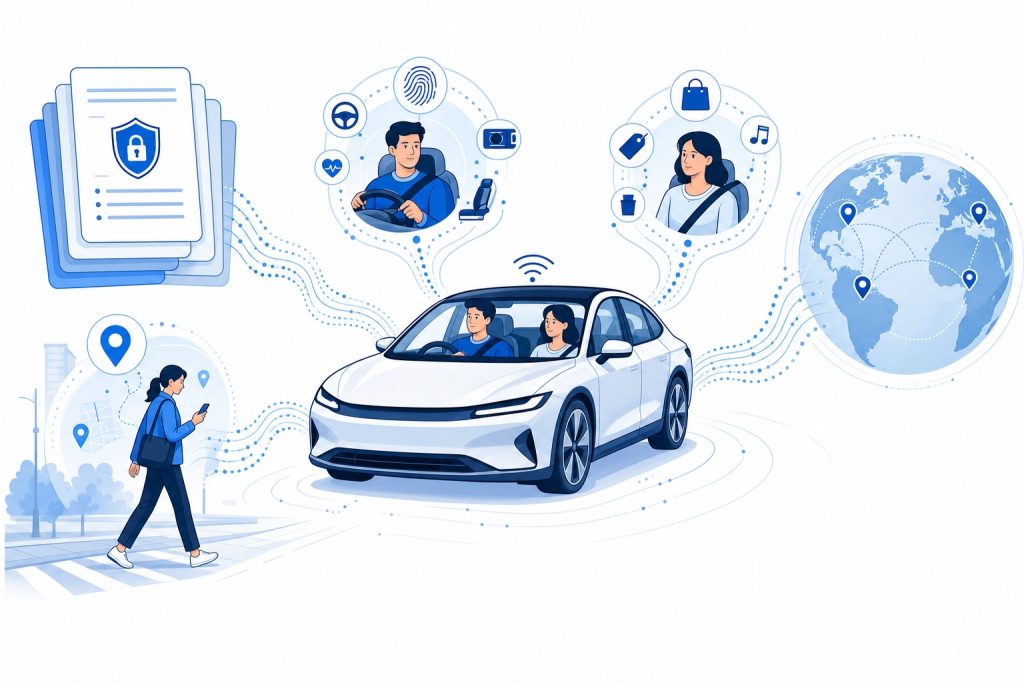
Connected vehicles increasingly operate as data-intensive platforms that collect vast amounts of personal information from drivers, passengers, and even nearby pedestrians. Yet privacy protections and public understanding have not kept pace with this expansion, and little empirical work has systematically connected what manufacturers disclose with how users perceive these data practices.
This work addresses the gap through two complementary studies. Study 1 analyzes the U.S. privacy policies of 17 major vehicle manufacturers, revealing extensive data collection practices, complex and fragmented privacy disclosures, and limited user control or transparency regarding third-party data sharing. Study 2 surveys 437 participants from the U.S., Germany, and China to examine comfort, expectations, and willingness to share data across different user roles, including drivers, passengers, and pedestrians. The results show that biometric and commercial information is perceived as particularly sensitive, that comfort with data collection varies significantly by role, and that a majority of users are willing to opt out of data collection practices. Overall, the findings highlight a substantial disconnect between industry data practices and public understanding, urging the need for clearer, role-aware, and culturally sensitive transparency mechanisms. The paper will be presented at NDSS 2027 in Seoul in March 2027.
[Paper]
Lachlan Moore, Yinan Zhao, Rei Yamagishi, Allan Wirth, Tatsuya Mori, “Privacy in Motion: Role Perspectives on Connected Vehicle Data Collection,” Proceedings of the Network and Distributed System Security Symposium (NDSS 2027), Seoul, Republic of Korea, March 2027.