Paper accepted at NDSS 2026: “The Heat is On”
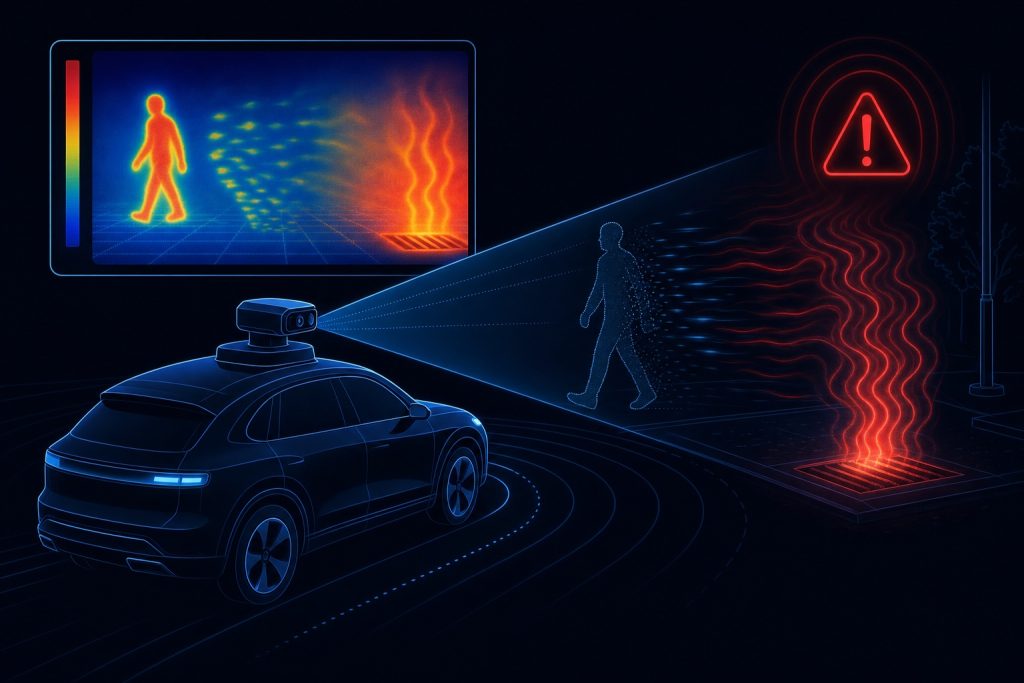
Thermal infrared cameras are increasingly adopted in the perception stacks of self-driving cars, robots, and drones because they can detect people and objects at night, in fog, and in heavy rain. This work systematically analyzes the vulnerabilities of three thermal cameras used in autonomous systems (FLIR Boson, InfiRay T2S, FPV XK-C130) and shows that flaws in the thermal image equalization process can break perception.
Evaluated against three fine-tuned thermal object detectors and two visible-thermal fusion models, the attack dropped mean average precision by 50% for pedestrian detection and by 45% for the fusion models. Real-world driving tests at speeds up to 40 km/h produced pedestrian misdetection rates as high as 100% and created false obstacles with a 91% success rate, with effects persisting for minutes after the attack ended. The paper proposes and evaluates three threat-aware signal processing algorithms that dynamically detect and suppress attacker-induced artifacts.
[Paper]
Sri Hrushikesh Varma Bhupathiraju, Shaoyuan Xie, Michael Clifford, Qi Alfred Chen, Takeshi Sugawara, Sara Rampazzi, “The Heat is On: Understanding and Mitigating Vulnerabilities of Thermal Image Perception in Autonomous Systems,” Network and Distributed System Security (NDSS 2026) Symposium, San Diego, CA, USA, February 2026.